As the cryptocurrency market steadily moves into an institutional phase, both trade size and execution complexity are increasing. Compared with the early retail driven environment, large capital flows are now far more frequent, and trading behavior has become much more sophisticated. Even so, one defining characteristic of the crypto market remains unchanged: liquidity is still fragmented across multiple trading venues and market makers, and market depth can fluctuate sharply across different time horizons.
Algorithmic trading has emerged in this context as a core piece of infrastructure in the crypto OTC market. It is not just an execution tool, but also a critical link connecting price discovery, liquidity access, and trade execution. In a modern OTC framework, algorithmic trading runs through nearly the entire workflow, from generating and distributing RFQ requests to filtering quotes and selecting the final execution path. From an industry structure perspective, the adoption of algorithmic trading is gradually reducing the OTC market’s reliance on manual communication and pushing it toward a more electronic, system driven model.
What Is Algorithmic Trading?
Algorithmic trading refers to the process in which computer systems automatically make trading decisions and execute orders based on pre set rules or models. These rules can be built around a wide range of variables, including price movements, market depth, time windows, and historical data patterns. Compared with traditional manual trading, the key strengths of algorithmic trading lie in its speed and consistency.
In the crypto market, the scope of algorithmic trading goes well beyond what is typical in traditional finance. On one hand, the market runs around the clock, making continuous human monitoring impractical. On the other hand, prices move frequently and market structure is complex, giving algorithms a stronger edge in both opportunity detection and risk control.
In the OTC context, algorithmic trading does not directly participate in public market matching. Instead, it is mainly used to optimize execution, especially when decisions must be made across multiple liquidity sources.
The Core Role of Algorithmic Trading in OTC
In the OTC trading framework, the role of algorithmic trading can be summed up as execution optimization. Unlike exchange based trading, where matching is the core logic, OTC trading places greater emphasis on execution path and execution quality, which makes the role of algorithms even more prominent.
First, algorithms can rapidly compare quotes from multiple sources. Because liquidity providers in the OTC market, such as market makers, often offer different prices, traders need to identify the best option within an extremely short time frame. Algorithms can dramatically improve this process through parallel processing.
Second, algorithms can make dynamic decisions by incorporating real time market data. For example, when market volatility rises, the system can automatically adjust its execution strategy to avoid trading at unfavorable prices. This kind of adaptability is difficult to achieve through manual execution alone.
RFQ Automation: The Key Entry Point for Algorithmic Trading
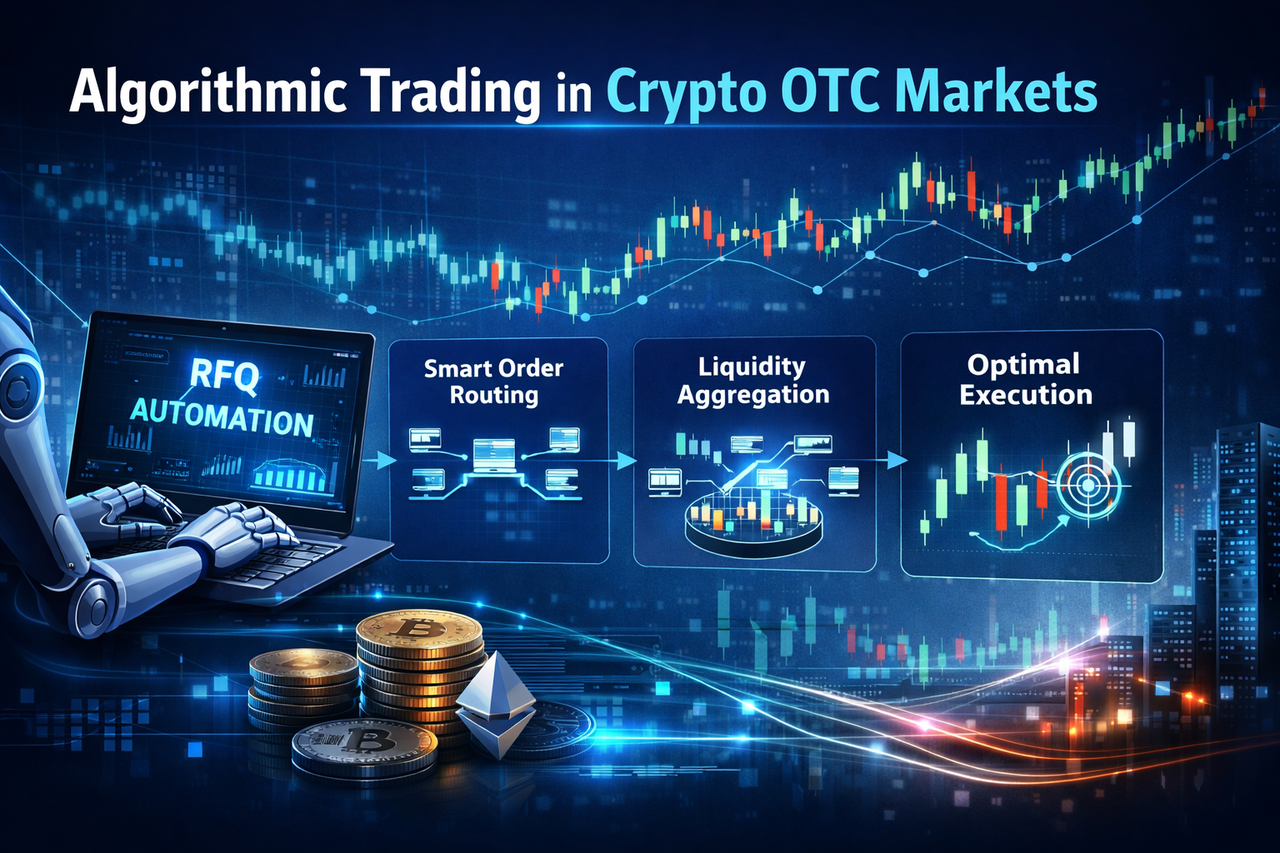
RFQ, or request for quote, is the core mechanism of OTC trading, and algorithmic trading turns it from a manual workflow into an automated system. In the traditional model, traders must manually send quote requests to multiple market makers and then organize the responses one by one, which is both time consuming and vulnerable to information delays.
With algorithms in place, the RFQ process can be automated. The system can distribute requests in milliseconds and simultaneously receive quotes from multiple liquidity sources. This automation not only improves efficiency, but also reduces errors caused by human intervention.
More importantly, algorithms can standardize quote data so that information from different sources becomes directly comparable, creating a reliable foundation for later decision making.
Smart Routing and Best Execution
Once multiple quotes have been collected, choosing the best execution path becomes the critical challenge. Smart order routing is the core technology used to solve this problem. By taking into account price, liquidity depth, fill probability, and execution speed, it dynamically selects the optimal path.
In practice, best execution does not simply mean the lowest price. It also requires weighing the certainty of completing the trade. In some cases, for example, a slightly higher quote may come with a much higher probability of execution, making it the better overall choice.
By quantifying these factors, algorithmic trading makes the decision process more systematic and repeatable, improving execution quality across the board.
Liquidity Aggregation: Addressing Market Fragmentation
One of the most notable features of the crypto OTC market is fragmented liquidity, with significant quote differences across market makers. Algorithmic trading addresses this through liquidity aggregation, bringing these scattered sources together within a unified framework and creating a deeper virtual liquidity pool.
This aggregation capability allows institutions to access multiple liquidity sources through a single interface and manage them centrally through algorithms. Compared with relying on a single market maker, this approach not only improves price competitiveness, but also strengthens execution stability.
How It Differs From Traditional OTC Execution
In traditional OTC trading, execution depends heavily on the trader’s experience and communication skills. While this model can offer flexibility, it has clear limitations in efficiency and consistency. In high frequency or highly complex scenarios in particular, manual handling often becomes the bottleneck.
Algorithmic trading, by contrast, standardizes execution through automation and data driven processes. Regardless of how market conditions change, the system can operate according to predefined rules, reducing uncertainty. That stability is one of the main reasons institutions adopt algorithmic trading.
Advantages and Challenges
The main advantages of algorithmic trading in OTC lie in efficiency and execution quality. Automated workflows allow trades to be completed more quickly while reducing slippage and market impact. Its ability to process data from multiple sources also enables traders to achieve better outcomes in more complex market environments.
At the same time, algorithmic trading comes with challenges. System stability is the first concern, because any technical failure can directly affect execution. In addition, algorithmic models must be continuously refined to keep up with changes in market structure. Dependence on liquidity providers also means system performance is influenced by external factors.
Use Cases
In OTC trading, algorithmic strategies are mainly used in situations where execution quality is especially important. Typical examples include institutional asset allocation, large capital inflows and outflows, and long term portfolio rebalancing. In these cases, trade sizes are larger and there is a stronger need for price stability and execution certainty.
For ordinary investors, by contrast, algorithmic trading is usually not the preferred tool, because trade sizes are smaller and operational complexity is relatively high.
Conclusion
Algorithmic trading is reshaping how the crypto OTC market operates. Through RFQ automation, smart routing, and liquidity aggregation, it not only improves trading efficiency, but also gives institutions a more stable and controllable path to execution. As the market continues to develop and technology keeps advancing, algorithmic trading will play an even more central role in the OTC ecosystem and push the industry toward greater maturity.
FAQs
Is algorithmic trading the same as an automated trading bot?
Not exactly. Algorithmic trading places more emphasis on strategy and execution optimization, not simply automated order placement.
What is the most important role of algorithmic trading in OTC?
Its main role is to optimize execution paths, improve trading efficiency, and reduce slippage.
Do all institutions use algorithmic trading?
Most institutions do, although the extent of use depends on their technical capabilities.
Does algorithmic trading increase risk?
If it is poorly designed, it can increase risk. However, mature systems are generally used to reduce execution risk.
Will OTC become fully automated in the future?
Not entirely. Automation will continue to increase, but human involvement will remain important, especially at the strategy level.