GateRouter: Building a Unified Hub for Multi-Model AI Development

Last Updated 2026-04-03 14:58:19
Reading Time: 4m
As the number of AI models grows rapidly, developers face escalating challenges with integration and management costs. This article offers a comprehensive analysis of how GateRouter simplifies multi-model application processes through a unified API, intelligent scheduling, and centralized management. These features boost development efficiency and optimize cost structures.

Surge in AI Models: The Hidden Burden in Development Workflows

In recent years, artificial intelligence has advanced rapidly, with a growing array of models emerging for various applications. From basic text generation to advanced reasoning and analysis, AI capabilities continue to expand—yet this evolution has also made development workflows more complex.

For developers, the core challenge extends beyond simply choosing a model; it lies in efficiently consolidating these services. Differences in API architectures, approval mechanisms, and invocation methods across platforms significantly increase both system maintenance and integration costs. This burden becomes even more pronounced when multiple models must be deployed simultaneously.

Unified Interface Design: Streamlining Multi-Model Integration
Unified Interface Design: Streamlining Multi-Model Integration

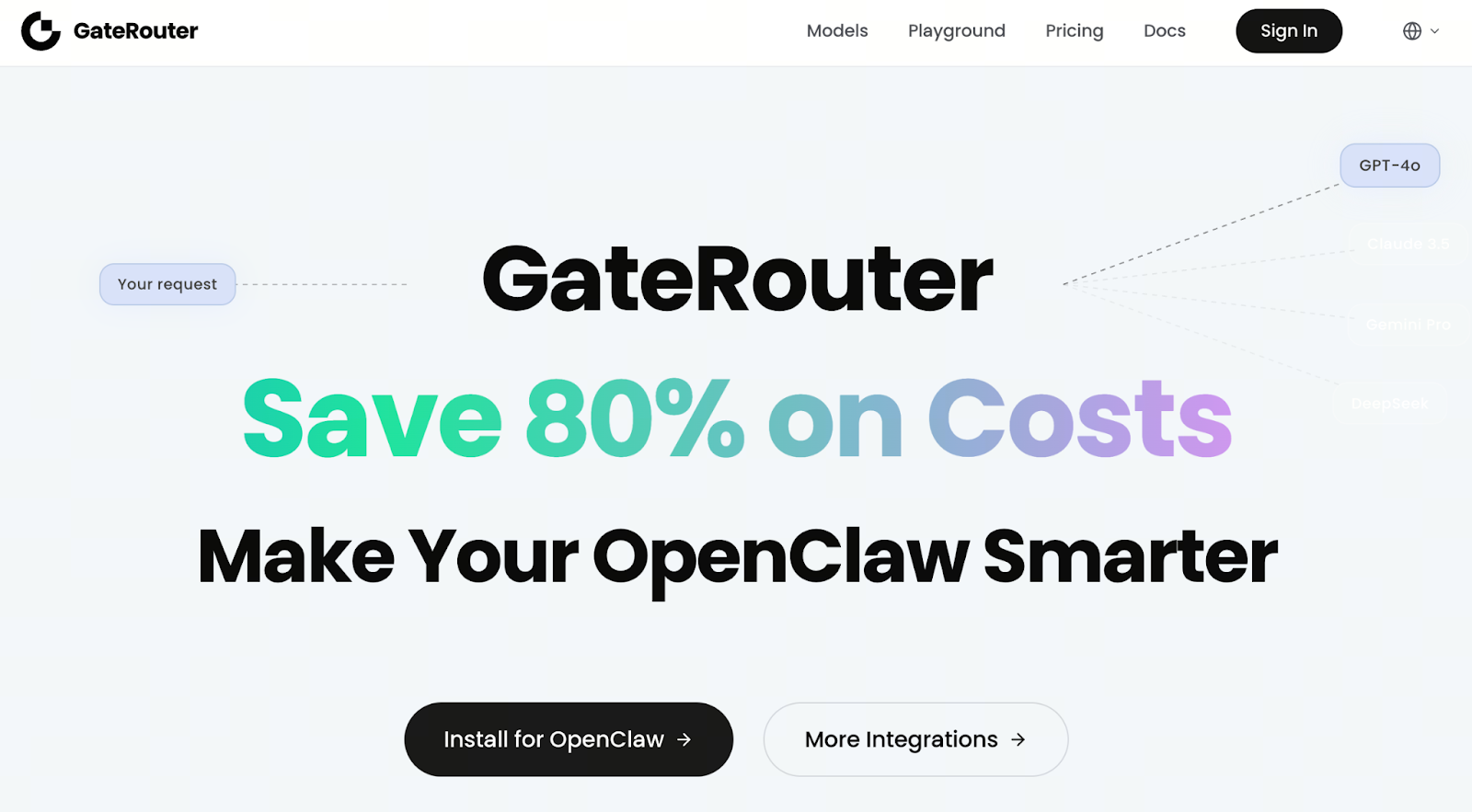
To address the complexity of multi-platform integration, GateRouter employs a unified entry-point architecture. Developers can connect to a range of AI model services through a single API, eliminating the need for repetitive integration work.

This architecture delivers several practical benefits:

  • Eliminates the need to connect to each model service individually

  • Enables model switching and invocation within the same environment

  • Reduces long-term maintenance and system complexity

A unified interface allows both simple applications and advanced features to be implemented within a single framework, making the development process more seamless.

View More about GateRouter: https://www.gaterouter.ai/

Automated Model Allocation: Balancing Efficiency and Cost

In real-world scenarios, task requirements for models can vary widely. GateRouter incorporates intelligent scheduling, automatically assigning the most appropriate model resources based on task characteristics.

The core logic includes:

  • Prioritizing low-cost models for basic tasks

  • Switching to high-performance models for complex requirements

This allocation method maintains output quality while preventing resource waste. For applications involving heavy computation or high-frequency requests, this mechanism helps optimize overall cost structure.

Integrated Management Tools: Enhancing Development Visibility

Beyond integration and scheduling, GateRouter enhances daily management with centralized tools that provide developers real-time insight into system operations.

Key features include:

  • API call status tracking

  • Usage data and log analysis

  • Cost distribution and resource allocation review

A built-in testing environment enables developers to compare different models in terms of effectiveness and cost, supporting more informed deployment decisions.

Security and Privacy: Balancing Performance and Protection

As AI applications expand into diverse scenarios, data security is increasingly critical. GateRouter’s design incorporates multi-layered protection to mitigate data leakage risks.

Key features include:

  • Encrypted transmission technology

  • Default settings that do not retain conversation content

  • Flexible log management configurations

Developers can adjust data recording policies as needed, striking a balance between debugging and privacy protection.

Expanding Application Scope: Multi-Role Use Cases

GateRouter is designed for a wide range of users:

  1. Developers and AI Agent Builders

Quickly integrate multiple model capabilities to create automated workflows.

  1. Enterprises and Institutions

Ideal for large-scale data analysis and processing, while optimizing resource utilization.

  1. Web3 Developers

Supports digital asset payments, making it easier to embed AI into blockchain applications.

Flexible Billing Model: Greater Cost Control

GateRouter uses a pay-as-you-go model, allowing developers to align spending with actual demand.

Advantages include:

  • No fixed cost pressure

  • Direct correlation between expenses and usage

  • Well-suited for fast-paced, iterative development environments

The platform supports multiple payment methods, ensuring smooth onboarding for users from diverse backgrounds.

The Integration of AI and Web3: An Emerging Trend

From an industry perspective, GateRouter serves as more than a technical tool—it is a foundational platform for integrating AI and digital assets. As AI Agents become increasingly prevalent in trading and automated decision-making, the ability to connect model capabilities with on-chain resources will be critical. Platforms like GateRouter are essential bridges driving this convergence.

Conclusion

In today’s era of parallel AI models, development challenges have shifted from model capability to integration efficiency. GateRouter redefines AI development through its unified interface, intelligent scheduling, and centralized management, lowering technical barriers and enabling flexible resource and cost allocation. As the AI ecosystem continues to expand, platforms that can effectively integrate and orchestrate model resources will be essential for scaling applications—and GateRouter is positioned as a key enabler in this evolution.

Author:  Allen
Disclaimer
* The information is not intended to be and does not constitute financial advice or any other recommendation of any sort offered or endorsed by Gate.
* This article may not be reproduced, transmitted or copied without referencing Gate. Contravention is an infringement of Copyright Act and may be subject to legal action.

Related Articles

What is Fartcoin? All You Need to Know About FARTCOIN
Intermediate

What is Fartcoin? All You Need to Know About FARTCOIN

Fartcoin (FARTCOIN) is a representative meme coin within the Solana ecosystem based on an AI-driven narrative. Its core concept originated from an experiment aimed at exploring the "boundaries between AI Agents and humor." More than just a digital asset with social attributes, the project deeply couples absurd humor culture with on-chain financial logic by integrating autonomous AI interaction models.
2026-04-04 22:01:19
Gold Price Forecast for the Next Five Years: 2026–2030 Trend Outlook and Investment Implications, Could It Reach $6,000?
Beginner

Gold Price Forecast for the Next Five Years: 2026–2030 Trend Outlook and Investment Implications, Could It Reach $6,000?

Analyze current gold price trends alongside authoritative five-year forecasts, integrating an evaluation of market risks and opportunities. This gives investors insight into the potential trajectory of gold prices and the main drivers expected to shape the market over the next five years.
2026-03-25 18:13:30
AI-Native Settlement Layers: How United Stables Is Building the Next Financial Rail
Beginner

AI-Native Settlement Layers: How United Stables Is Building the Next Financial Rail

Stablecoins were originally designed as dollar substitutes within exchanges, primarily used for asset pricing and trade settlement. As on-chain financial ecosystems have matured, their role has expanded beyond simple payments to include collateral assets, cross-chain liquidity mediums, and unified settlement units. In particular, as AI systems and automated agents begin to participate directly in economic activity, demand has risen sharply for programmable value units capable of instant settlement. This shift is pushing stablecoins toward the role of foundational financial infrastructure.
2026-03-25 03:16:17
Aster vs Hyperliquid: Which Perp DEX Will Prevail?
Beginner

Aster vs Hyperliquid: Which Perp DEX Will Prevail?

Aster and Hyperliquid are the two representative protocols of the "purpose-built L1 path" within the current decentralized perpetual exchange (Perp DEX) sector. As a pioneer in the field, Hyperliquid has built a deep liquidity moat through its highly mature order book architecture and strong community consensus. Conversely, Aster, as a rising challenger, seeks to leapfrog the competition in high-performance trading through more aggressive multi-chain aggregation logic, private transaction modules, and an underlying execution environment optimized for 2026 market demands.
2026-03-24 11:58:33
Aerodrome Tokenomics: How ve(3,3) Powers Base's Most Profitable DEX
Beginner

Aerodrome Tokenomics: How ve(3,3) Powers Base's Most Profitable DEX

AERO is the native token of Aerodrome Finance, a core decentralized exchange and liquidity protocol in the Base ecosystem. It is primarily used for liquidity incentives and ecosystem operations. veAERO is a governance NFT that users receive by locking AERO, representing both voting power and the right to share protocol revenue. Through a dual track structure of AERO as a utility token and veAERO as a governance credential, Aerodrome separates liquidity usage value from long term governance power, allowing participants to act as liquidity providers, governance decision makers, and revenue sharers within the same system.
2026-03-25 06:40:31
Hybrid Collateral Stablecoins: Inside United Stables' Stability and Yield Architecture
Beginner

Hybrid Collateral Stablecoins: Inside United Stables' Stability and Yield Architecture

In the early stages of the crypto market, traditional stablecoins mainly relied on single-reserve or single-collateral models. Their primary focus was price stability and payment convenience, which allowed them to become foundational tools for on-chain trading and capital flows. As the market has entered a more mature financial phase, however, this structure has begun to reveal limitations, including high concentration risk and the difficulty of balancing liquidity with yield. These constraints have driven the evolution toward multi-layer collateral and portfolio-based designs, such as the dual-layer hybrid collateral architecture proposed by United Stables, which seeks to redefine the underlying logic of stable assets.
2026-03-25 03:17:39