CAM vs DOT: Comparing Two Approaches to Network Traffic Management

Introduction: CAM vs DOT Investment Comparison
In the cryptocurrency market, the comparison between Camino Network (CAM) vs Polkadot (DOT) has been an unavoidable topic for investors. The two not only show significant differences in market cap ranking, application scenarios, and price performance, but also represent different cryptocurrency asset positioning.
Camino Network (CAM): Since its launch, it has gained market recognition for its focus on the $11 trillion travel industry.
Polkadot (DOT): Since its inception in 2020, it has been hailed as a pioneer in blockchain interoperability, and is one of the cryptocurrencies with high global trading volume and market capitalization.
This article will comprehensively analyze the investment value comparison between CAM and DOT, focusing on historical price trends, supply mechanisms, institutional adoption, technological ecosystems, and future predictions, attempting to answer the question investors care about most:
"Which is the better buy right now?"
I. Price History Comparison and Current Market Status
CAM and DOT Historical Price Trends
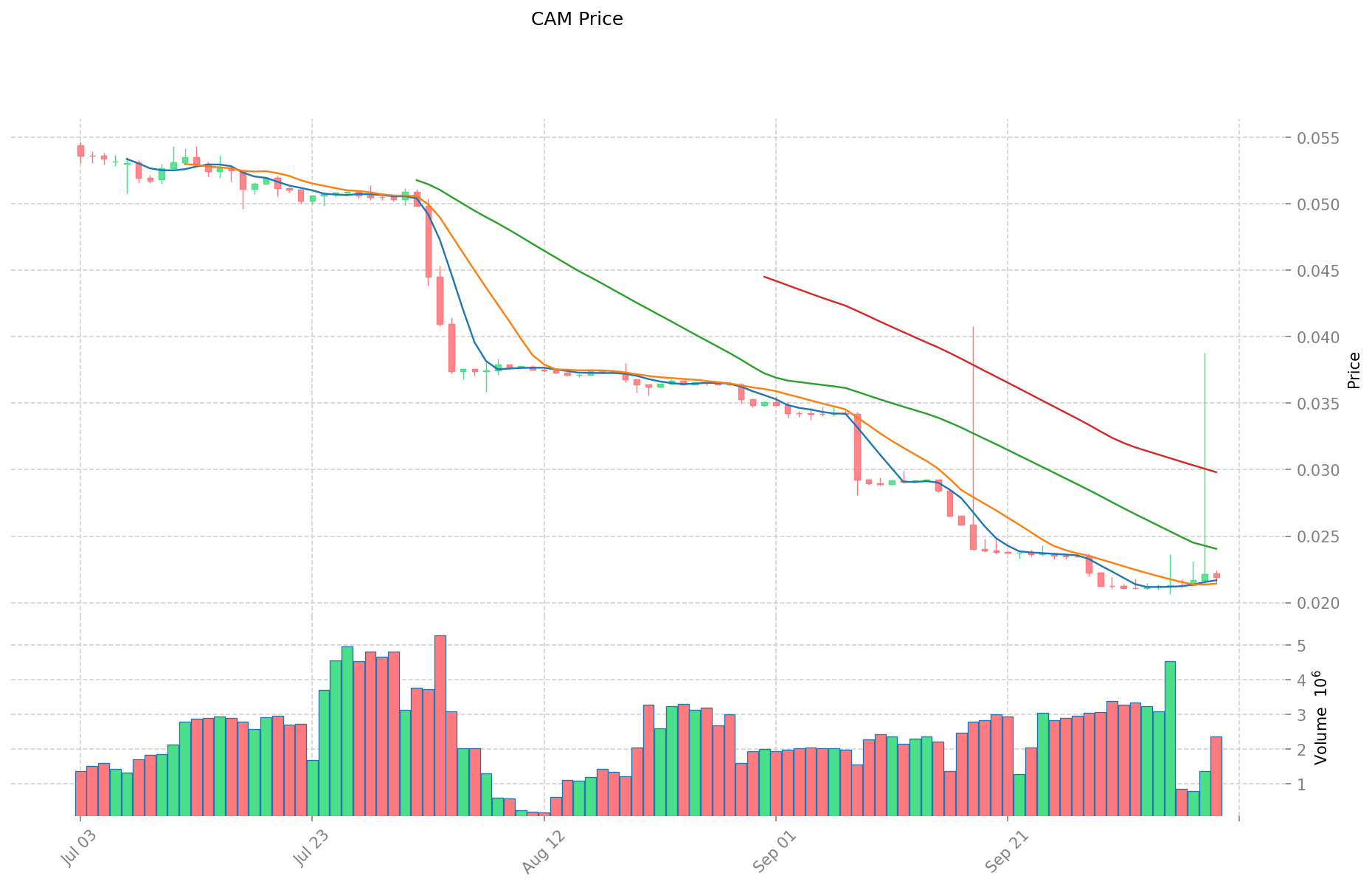
- 2025: CAM experienced a significant price drop, falling from its all-time high of $0.19806 on January 29 to its all-time low of $0.02062 on October 5.
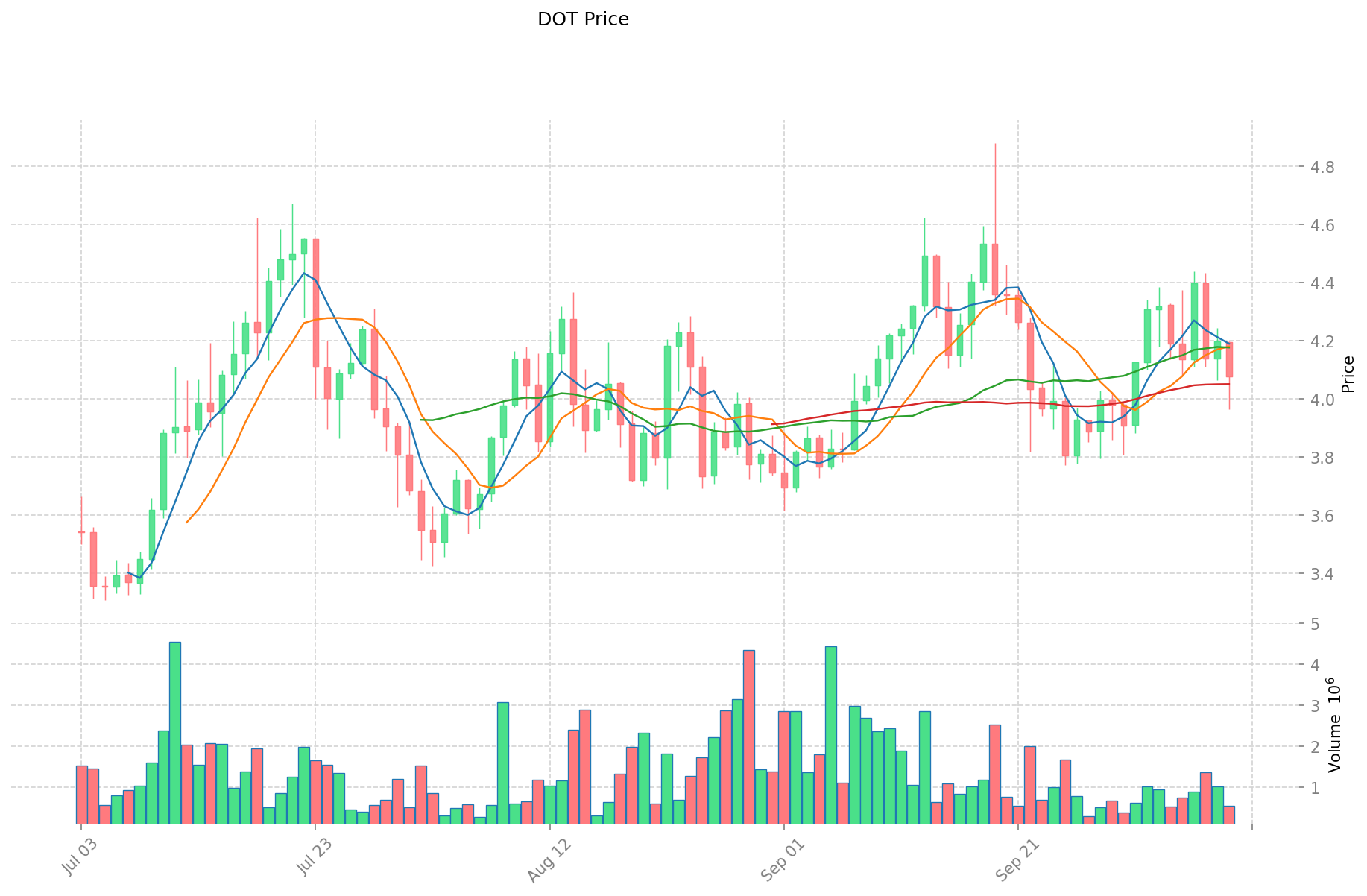
- 2021: DOT reached its all-time high of $54.98 on November 4, demonstrating strong market performance.
- Comparative analysis: In the recent market cycle, CAM has seen a dramatic decline of over 88% from its peak, while DOT has shown more stability, currently trading at about 92% below its all-time high.
Current Market Situation (2025-10-10)
- CAM current price: $0.0219
- DOT current price: $4.077
- 24-hour trading volume: CAM $53,546.34 vs DOT $2,159,385.50
- Market Sentiment Index (Fear & Greed Index): 64 (Greed)
Click to view real-time prices:
- View CAM current price Market Price
- View DOT current price Market Price
II. Core Factors Influencing CAM vs DOT Investment Value
Supply Mechanisms Comparison (Tokenomics)
- CAM: The token has a fixed maximum supply cap of 4,210,000,000 CAM.
- DOT: Inflationary token with an annual inflation rate between 10% and 10% set by governance.
- 📌 Historical pattern: Fixed supply models like CAM tend to create scarcity-driven value appreciation over time, while DOT's inflation requires strong network growth to outpace dilution.
Institutional Adoption and Market Applications
- Institutional holdings: DOT currently has broader institutional adoption with support from major funds and exchanges.
- Enterprise adoption: DOT has established partnerships with major enterprises through Polkadot's ecosystem, while CAM is building corporate relationships through the Camino Network.
- National policies: Both projects face varying regulatory treatment across jurisdictions, with regulatory clarity developing gradually for both networks.
Technical Development and Ecosystem Building
- CAM technical upgrade: Recently launched mainnet with focus on real-world asset tokenization and regulatory compliance through the use of permissioned validators.
- DOT technical development: Established parachain ecosystem with cross-chain interoperability as core feature and continued development of shared security model.
- Ecosystem comparison: DOT has a more mature DeFi ecosystem with numerous active parachains, while CAM is developing specialized infrastructure for compliant digital assets with focus on tokenized real-world assets.
Macroeconomic and Market Cycles
- Performance in inflationary environments: CAM's fixed supply model potentially provides better protection against inflation compared to DOT's inflationary model.
- Macroeconomic monetary policy: Rising interest rates typically impact both assets negatively, but fixed-supply assets may demonstrate more resilience in the long term.
- Geopolitical factors: Both networks offer cross-border transaction capabilities, with CAM's focus on compliance potentially offering advantages in uncertain regulatory environments.
III. 2025-2030 Price Prediction: CAM vs DOT
Short-term Forecast (2025)
- CAM: Conservative $0.0181687 - $0.02189 | Optimistic $0.02189 - $0.0293326
- DOT: Conservative $2.53332 - $4.086 | Optimistic $4.086 - $6.00642
Mid-term Forecast (2027)
- CAM may enter a growth phase, with estimated prices between $0.0163400094 and $0.0304262244
- DOT may enter a bullish market, with estimated prices between $4.004167635 and $7.66014678
- Key drivers: Institutional capital inflow, ETF, ecosystem development
Long-term Forecast (2030)
- CAM: Base scenario $0.03857842412424 - $0.042822050777906 | Optimistic scenario $0.042822050777906+
- DOT: Base scenario $9.36708282081 - $13.4885992619664 | Optimistic scenario $13.4885992619664+
Disclaimer
CAM:
| 年份 | 预测最高价 | 预测平均价格 | 预测最低价 | 涨跌幅 |
|---|---|---|---|---|
| 2025 | 0.0293326 | 0.02189 | 0.0181687 | 0 |
| 2026 | 0.03073356 | 0.0256113 | 0.024330735 | 16 |
| 2027 | 0.0304262244 | 0.02817243 | 0.0163400094 | 28 |
| 2028 | 0.038382118632 | 0.0292993272 | 0.019337555952 | 33 |
| 2029 | 0.04331612533248 | 0.033840722916 | 0.0287646144786 | 54 |
| 2030 | 0.042822050777906 | 0.03857842412424 | 0.023918622957028 | 76 |
DOT:
| 年份 | 预测最高价 | 预测平均价格 | 预测最低价 | 涨跌幅 |
|---|---|---|---|---|
| 2025 | 6.00642 | 4.086 | 2.53332 | 0 |
| 2026 | 6.560073 | 5.04621 | 3.4314228 | 23 |
| 2027 | 7.66014678 | 5.8031415 | 4.004167635 | 42 |
| 2028 | 8.751137382 | 6.73164414 | 4.5102015738 | 64 |
| 2029 | 10.99277488062 | 7.741390761 | 4.72224836421 | 89 |
| 2030 | 13.4885992619664 | 9.36708282081 | 8.2430328823128 | 129 |
IV. Investment Strategy Comparison: CAM vs DOT
Long-term vs Short-term Investment Strategies
- CAM: Suitable for investors focused on real-world asset tokenization and regulatory compliance
- DOT: Suitable for investors seeking ecosystem diversity and interoperability potential
Risk Management and Asset Allocation
- Conservative investors: CAM: 30% vs DOT: 70%
- Aggressive investors: CAM: 50% vs DOT: 50%
- Hedging tools: Stablecoin allocation, options, cross-currency portfolios
V. Potential Risk Comparison
Market Risks
- CAM: Higher volatility due to lower market cap and trading volume
- DOT: Exposure to broader crypto market trends and parachain ecosystem performance
Technical Risks
- CAM: Scalability, network stability in early stages
- DOT: Parachain auction dynamics, cross-chain security
Regulatory Risks
- Global regulatory policies may impact both differently, with CAM's compliance focus potentially offering advantages
VI. Conclusion: Which Is the Better Buy?
📌 Investment Value Summary:
- CAM advantages: Fixed supply, focus on regulated real-world asset tokenization
- DOT advantages: Established ecosystem, interoperability, institutional adoption
✅ Investment Advice:
- New investors: Consider a balanced approach, leaning towards DOT for its established market presence
- Experienced investors: Explore CAM for potential growth, maintain DOT for ecosystem exposure
- Institutional investors: Evaluate CAM for compliance-focused opportunities, continue DOT allocation for ecosystem diversity
⚠️ Risk Warning: Cryptocurrency markets are highly volatile. This article does not constitute investment advice. None
FAQ
Q1: What are the main differences between CAM and DOT? A: CAM has a fixed maximum supply of 4,210,000,000 tokens and focuses on the travel industry and real-world asset tokenization. DOT has an inflationary supply model and focuses on blockchain interoperability with a more established ecosystem.
Q2: Which cryptocurrency has shown better price performance recently? A: DOT has shown more price stability recently, trading at about 92% below its all-time high, while CAM has experienced a more dramatic decline of over 88% from its peak.
Q3: How do the market capitalizations and trading volumes of CAM and DOT compare? A: DOT has a significantly larger market capitalization and trading volume compared to CAM. As of the current data, DOT's 24-hour trading volume is $2,159,385.50, while CAM's is $53,546.34.
Q4: What are the key technological features of each project? A: CAM focuses on regulatory compliance and real-world asset tokenization using permissioned validators. DOT emphasizes cross-chain interoperability and has developed a parachain ecosystem with shared security.
Q5: How do analysts predict the future prices of CAM and DOT? A: For 2030, analysts predict CAM's base scenario price range to be $0.03857842412424 - $0.042822050777906, while DOT's base scenario is predicted to be $9.36708282081 - $13.4885992619664.
Q6: What are the main risks associated with investing in CAM and DOT? A: CAM faces higher volatility due to lower market cap and trading volume, as well as potential scalability issues. DOT is exposed to broader crypto market trends and risks associated with its parachain ecosystem and cross-chain security.
Q7: How might institutional investors approach CAM and DOT? A: Institutional investors might evaluate CAM for compliance-focused opportunities in real-world asset tokenization, while maintaining DOT allocation for exposure to a diverse blockchain ecosystem and interoperability solutions.
Share
Content
Introduction: CAM vs DOT Investment Comparison
I. Price History Comparison and Current Market Status
II. Core Factors Influencing CAM vs DOT Investment Value
III. 2025-2030 Price Prediction: CAM vs DOT
IV. Investment Strategy Comparison: CAM vs DOT
V. Potential Risk Comparison
VI. Conclusion: Which Is the Better Buy?
FAQ
How to Buy Cryptocurrency


Trending Cryptocurrencies



RWA on Avalanche (AVAX): How Real-World Assets Come On-Chain

Is Ondo Finance (ONDO) a good investment?: Analyzing the potential and risks of this innovative DeFi protocol

2025 QNT Price Prediction: Analyzing Potential Growth and Market Trends for Quant Network's Token

Is ELYSIA (EL) a Good Investment?: Analyzing the Potential and Risks of This Emerging Cryptocurrency in 2024

Is XDC Network (XDC) a good investment?: Analyzing the potential of this enterprise-focused blockchain platform
OCT vs AVAX: Comparing Two Promising Blockchain Platforms for Smart Contract Development

Guide to Participating and Claiming SEI Airdrop Rewards

Effective Strategies for Algorithmic Trading in Cryptocurrency

Understanding Bitcoin Valuation with the Stock-to-Flow Model

Understanding How Transaction Speed Impacts Blockchain Efficiency

Web3 Identity Management with ENS Domains