MANEKI vs NEAR: Battle of the Blockchain Protocols for Scalable Decentralized Applications

Introduction: MANEKI vs NEAR Investment Comparison
In the cryptocurrency market, the comparison between MANEKI and NEAR has always been a topic that investors can't avoid. The two not only have significant differences in market cap ranking, application scenarios, and price performance, but also represent different positions in crypto assets.
MANEKI (MANEKI): Since its launch, it has gained market recognition as a Solana native cat coin symbolizing good luck, success, prosperity, wisdom, and leadership.
NEAR (NEAR): Introduced in 2020, it has been hailed as a highly scalable basic protocol ensuring fast support for DApp operation on mobile devices.
This article will comprehensively analyze the investment value comparison between MANEKI and NEAR, focusing on historical price trends, supply mechanisms, institutional adoption, technological ecosystems, and future predictions, and attempt to answer the question that investors are most concerned about:
"Which is the better buy right now?"
I. Price History Comparison and Current Market Status
MANEKI (Coin A) and NEAR (Coin B) Historical Price Trends
- 2024: MANEKI reached its all-time high of $0.028 on April 25, 2024.
- 2022: NEAR hit its all-time high of $20.44 on January 17, 2022.
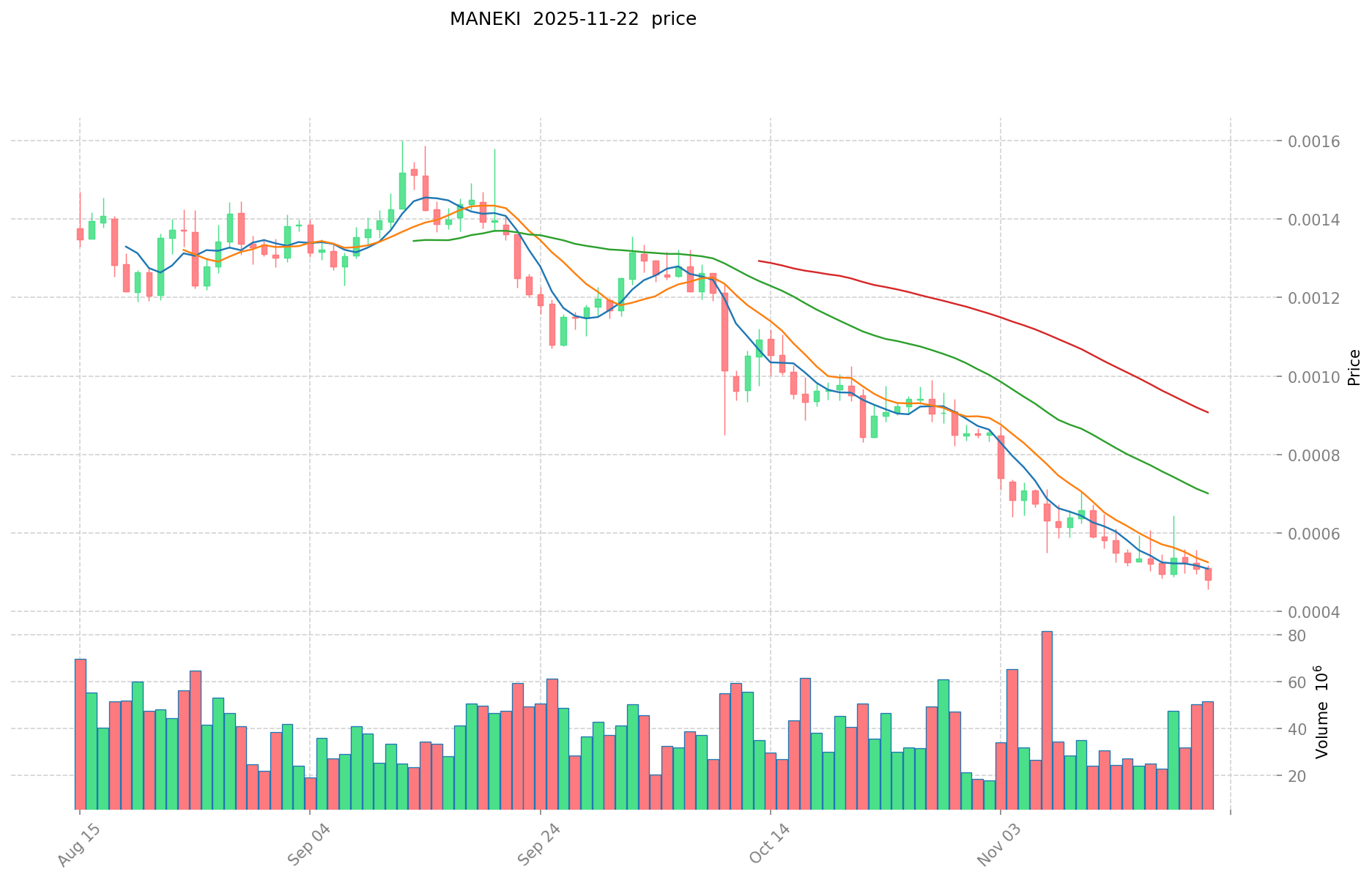
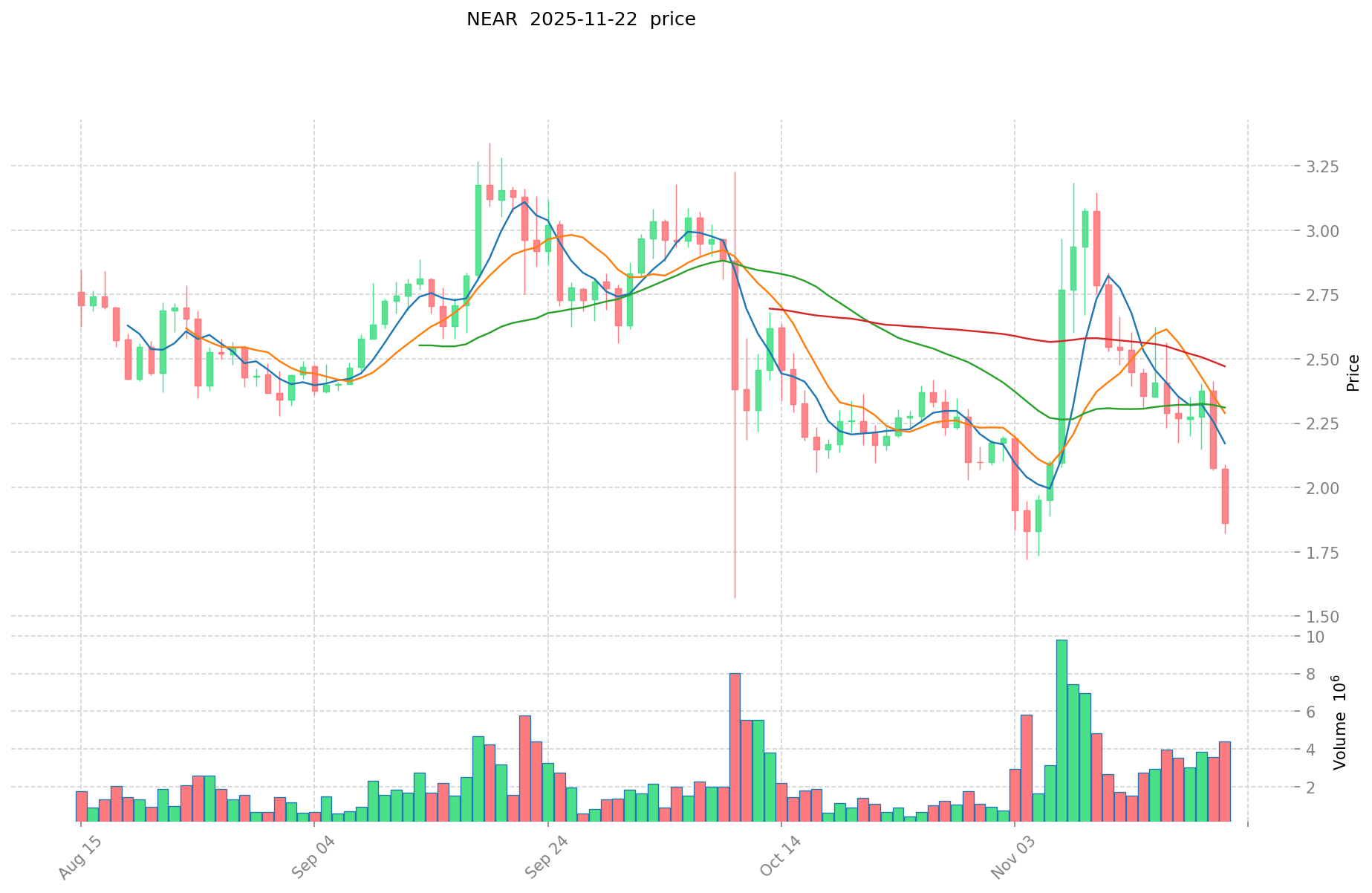
- Comparative analysis: In the recent market cycle, MANEKI dropped from its high of $0.028 to a low of $0.000456, while NEAR declined from $20.44 to its current price of $1.821.
Current Market Situation (2025-11-23)
- MANEKI current price: $0.0004931
- NEAR current price: $1.821
- 24-hour trading volume: $16,513.57 (MANEKI) vs $4,374,994.34 (NEAR)
- Market Sentiment Index (Fear & Greed Index): 11 (Extreme Fear)
Click to view real-time prices:
- View MANEKI current price Market Price
- View NEAR current price Market Price
II. Core Factors Affecting MANEKI vs NEAR Investment Value
Supply Mechanism Comparison (Tokenomics)
-
MANEKI: Fixed supply of 1 billion tokens with deflationary mechanisms through burning of transaction fees
-
NEAR: Inflationary model with initial supply of 1 billion tokens, annual inflation rate of 5% with 70% going to staking rewards
-
📌 Historical Pattern: Deflationary tokens like MANEKI tend to experience higher price appreciation during bull markets due to supply constraints, while NEAR's predictable inflation model provides stability but may limit upside potential during market rallies.
Institutional Adoption and Market Applications
- Institutional Holdings: NEAR has gained more institutional traction with backing from major venture capital firms including a16z, Coinbase Ventures, and Pantera Capital
- Enterprise Adoption: NEAR demonstrates stronger enterprise integration through partnerships with Sweatcoin and Aurora Labs, while MANEKI is still developing its enterprise ecosystem
- Regulatory Attitudes: Both projects face similar regulatory scrutiny, though NEAR's established foundation provides more regulatory engagement capabilities
Technical Development and Ecosystem Building
- MANEKI Technical Upgrades: Implementation of multi-chain compatibility and integration with major DEXs to enhance liquidity and trading options
- NEAR Technical Development: Nightshade sharding technology allows for enhanced scalability, with transaction throughput of up to 100,000 TPS and reduced fees
- Ecosystem Comparison: NEAR has a more mature ecosystem with over 800 projects spanning DeFi, NFTs, and gaming; MANEKI is focusing on meme coin utility expansion through community governance and social token applications
Macroeconomic Factors and Market Cycles
- Performance in Inflationary Environments: MANEKI's fixed supply model theoretically offers better inflation protection, while NEAR's staking rewards provide yield generation during economic uncertainty
- Monetary Policy Impact: Both tokens show sensitivity to Federal Reserve decisions, with NEAR demonstrating slightly more resilience during rate hike cycles
- Geopolitical Factors: NEAR's decentralized infrastructure provides better resilience to regional restrictions, while MANEKI benefits from broader meme coin interest during global uncertainty periods
III. 2025-2030 Price Prediction: MANEKI vs NEAR
Short-term Prediction (2025)
- MANEKI: Conservative $0.000429781 - $0.0004829 | Optimistic $0.0004829 - $0.00057948
- NEAR: Conservative $1.43148 - $1.812 | Optimistic $1.812 - $2.24688
Mid-term Prediction (2027)
- MANEKI may enter a growth phase, with an estimated price range of $0.000334224748 - $0.00083556187
- NEAR may enter a steady growth phase, with an estimated price range of $1.117815552 - $2.235631104
- Key drivers: Institutional capital inflow, ETF, ecosystem development
Long-term Prediction (2030)
- MANEKI: Base scenario $0.000442089100922 - $0.000818683520226 | Optimistic scenario $0.000818683520226 - $0.001064288576293
- NEAR: Base scenario $2.197901599875072 - $2.6165495236608 | Optimistic scenario $2.6165495236608 - $3.349183390285824
Disclaimer
MANEKI:
| 年份 | 预测最高价 | 预测平均价格 | 预测最低价 | 涨跌幅 |
|---|---|---|---|---|
| 2025 | 0.00057948 | 0.0004829 | 0.000429781 | -2 |
| 2026 | 0.0007542898 | 0.00053119 | 0.0004515115 | 7 |
| 2027 | 0.00083556187 | 0.0006427399 | 0.000334224748 | 30 |
| 2028 | 0.00083524050005 | 0.000739150885 | 0.0005026226018 | 49 |
| 2029 | 0.000850171347927 | 0.000787195692525 | 0.000700604166347 | 59 |
| 2030 | 0.001064288576293 | 0.000818683520226 | 0.000442089100922 | 66 |
NEAR:
| 年份 | 预测最高价 | 预测平均价格 | 预测最低价 | 涨跌幅 |
|---|---|---|---|---|
| 2025 | 2.24688 | 1.812 | 1.43148 | 0 |
| 2026 | 2.1106176 | 2.02944 | 1.623552 | 11 |
| 2027 | 2.235631104 | 2.0700288 | 1.117815552 | 13 |
| 2028 | 2.92784873472 | 2.152829952 | 1.9375469568 | 18 |
| 2029 | 2.6927597039616 | 2.54033934336 | 1.6004137863168 | 39 |
| 2030 | 3.349183390285824 | 2.6165495236608 | 2.197901599875072 | 43 |
IV. Investment Strategy Comparison: MANEKI vs NEAR
Long-term vs Short-term Investment Strategy
- MANEKI: Suitable for investors focused on meme coin potential and community-driven growth
- NEAR: Suitable for investors seeking ecosystem development and scalability solutions
Risk Management and Asset Allocation
- Conservative investors: MANEKI: 5% vs NEAR: 15%
- Aggressive investors: MANEKI: 15% vs NEAR: 30%
- Hedging tools: Stablecoin allocation, options, cross-currency portfolio
V. Potential Risk Comparison
Market Risk
- MANEKI: High volatility due to meme coin nature and speculative trading
- NEAR: Susceptible to overall crypto market trends and competition from other Layer 1 platforms
Technical Risk
- MANEKI: Scalability, network stability on Solana
- NEAR: Smart contract vulnerabilities, potential issues with sharding implementation
Regulatory Risk
- Global regulatory policies may have different impacts on both tokens, with NEAR potentially facing more scrutiny due to its broader ecosystem
VI. Conclusion: Which Is the Better Buy?
📌 Investment Value Summary:
- MANEKI advantages: Deflationary model, meme coin appeal, potential for rapid price appreciation
- NEAR advantages: Established ecosystem, institutional backing, scalability solutions
✅ Investment Advice:
- Novice investors: Consider a small allocation to NEAR for exposure to a more established ecosystem
- Experienced investors: Balanced approach with both MANEKI and NEAR, adjusting based on risk tolerance
- Institutional investors: Focus on NEAR due to its stronger fundamentals and institutional adoption
⚠️ Risk Warning: The cryptocurrency market is highly volatile, and this article does not constitute investment advice. None
VII. FAQ
Q1: What are the main differences between MANEKI and NEAR? A: MANEKI is a Solana-based meme coin with a fixed supply and deflationary mechanism, while NEAR is a Layer 1 blockchain platform with an inflationary model and focus on scalability. MANEKI has higher volatility and speculative appeal, while NEAR offers a more established ecosystem and institutional backing.
Q2: Which token has shown better price performance historically? A: NEAR has shown better historical price performance, reaching an all-time high of $20.44 in January 2022. MANEKI, being a newer token, reached its all-time high of $0.028 in April 2024. However, both have experienced significant declines from their peak prices.
Q3: How do the supply mechanisms of MANEKI and NEAR differ? A: MANEKI has a fixed supply of 1 billion tokens with deflationary mechanisms through burning of transaction fees. NEAR has an inflationary model with an initial supply of 1 billion tokens and an annual inflation rate of 5%, with 70% going to staking rewards.
Q4: Which token has greater institutional adoption? A: NEAR has gained more institutional traction, with backing from major venture capital firms including a16z, Coinbase Ventures, and Pantera Capital. It also demonstrates stronger enterprise integration through partnerships with companies like Sweatcoin and Aurora Labs.
Q5: What are the key technical developments for each token? A: MANEKI has implemented multi-chain compatibility and integration with major DEXs. NEAR has developed Nightshade sharding technology, allowing for enhanced scalability with transaction throughput of up to 100,000 TPS and reduced fees.
Q6: How do the long-term price predictions compare for MANEKI and NEAR? A: By 2030, MANEKI's base scenario predicts a range of $0.000442089100922 - $0.000818683520226, while NEAR's base scenario predicts a range of $2.197901599875072 - $2.6165495236608. NEAR is expected to have a higher absolute price, but MANEKI may have potential for higher percentage gains due to its lower starting price.
Q7: What are the recommended investment strategies for MANEKI and NEAR? A: For conservative investors, a suggested allocation is 5% MANEKI and 15% NEAR. For aggressive investors, the suggestion is 15% MANEKI and 30% NEAR. MANEKI is suitable for those focused on meme coin potential, while NEAR is better for those seeking established ecosystem development and scalability solutions.
Q8: What are the primary risks associated with investing in MANEKI and NEAR? A: MANEKI faces high volatility risks due to its meme coin nature and potential scalability issues on Solana. NEAR is susceptible to overall crypto market trends, competition from other Layer 1 platforms, and potential smart contract vulnerabilities. Both tokens may face regulatory risks, with NEAR potentially facing more scrutiny due to its broader ecosystem.
Share
Content
Introduction: MANEKI vs NEAR Investment Comparison
I. Price History Comparison and Current Market Status
II. Core Factors Affecting MANEKI vs NEAR Investment Value
III. 2025-2030 Price Prediction: MANEKI vs NEAR
IV. Investment Strategy Comparison: MANEKI vs NEAR
V. Potential Risk Comparison
VI. Conclusion: Which Is the Better Buy?
VII. FAQ
How to Buy Cryptocurrency


Trending Cryptocurrencies


DON vs APT: Comparing Decentralized Oracle Networks and Automated Price Takers in DeFi

MEME vs APT: The Battle of Digital Influence in Modern Cybersecurity Landscape

MEMEFI vs APT: The Battle of Investment Strategies in Volatile Markets
PulseX Price Prediction: Will Richard Heart’s DEX Finally Moon?

MEME Coin

What is a Ponzi Scheme? How to Spot and Avoid One
Xenea Daily Quiz Answer December 13, 2025

Guide to Bridging Assets to the Polygon Network

Guide to Integrating Polygon Network with Your Crypto Wallet

Beginner's Guide to Secure Digital Asset Storage with BEP2

Guide to Bridging Assets to Polygon PoS Network