REQ vs APT: Comparing Request-Based and Advanced Persistent Threat Approaches in Cybersecurity

Introduction: Investment Comparison of REQ vs APT
In the cryptocurrency market, the comparison between Request (REQ) and Aptos (APT) has been an unavoidable topic for investors. The two not only show significant differences in market cap ranking, application scenarios, and price performance, but also represent different positioning in crypto assets.
Request (REQ): Since its launch in 2017, it has gained market recognition for its decentralized payment network built on Ethereum.
Aptos (APT): Introduced in 2022, it has been hailed as a high-performance Layer 1 blockchain, focusing on security and scalability.
This article will comprehensively analyze the investment value comparison between REQ and APT, focusing on historical price trends, supply mechanisms, institutional adoption, technological ecosystems, and future predictions, attempting to answer the question investors care about most:
"Which is the better buy right now?"
I. Price History Comparison and Current Market Status
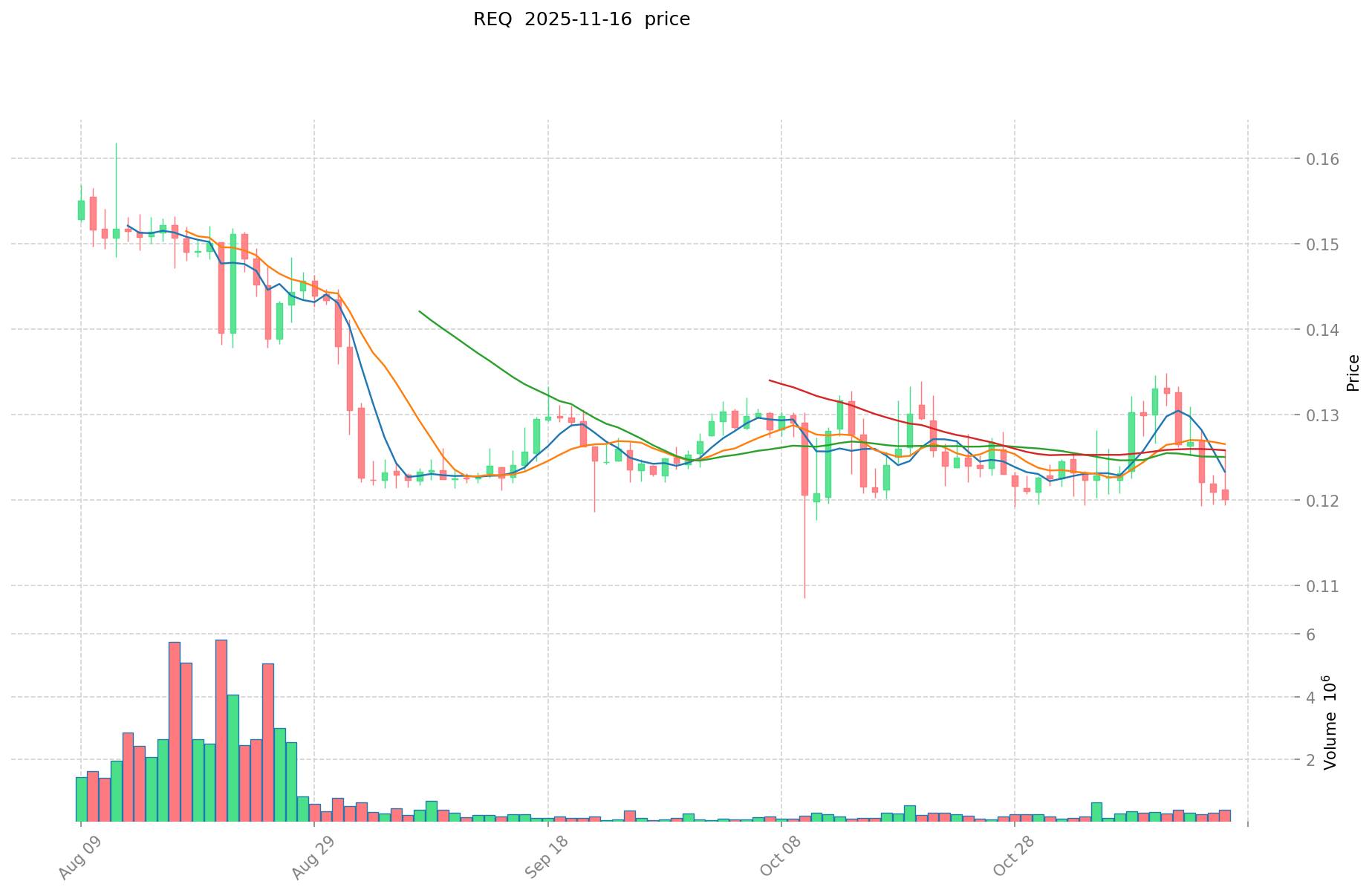
REQ (Coin A) and APT (Coin B) Historical Price Trends
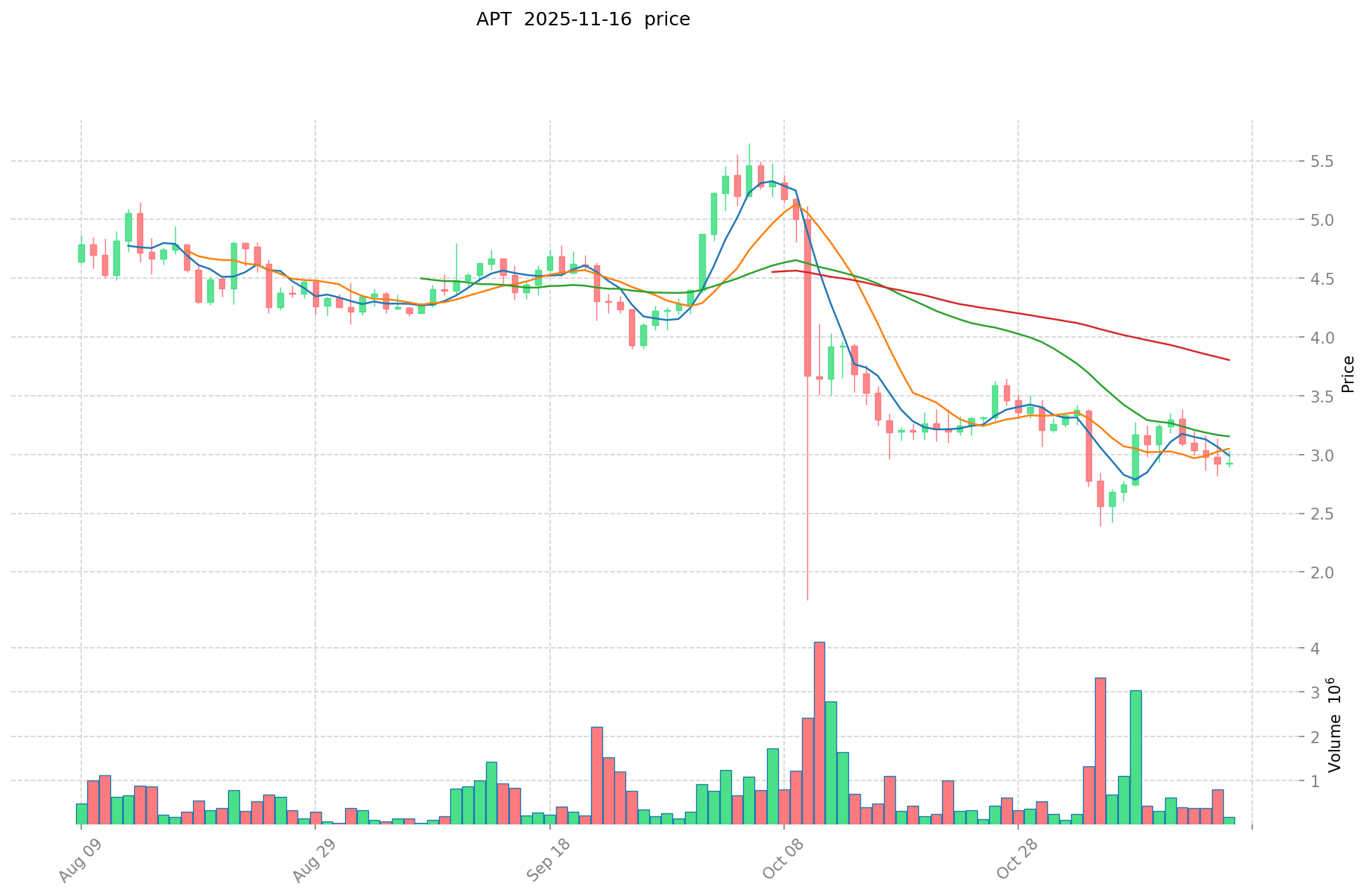
- 2023: APT reached its all-time high of $19.92, driven by increased adoption and market optimism.
- 2025: APT hit its all-time low of $2.41, possibly due to broader market conditions or project-specific challenges.
- Comparative analysis: During this market cycle, APT experienced a significant drop from its peak of $19.92 to its low of $2.41, representing a decline of approximately 87.9%.
Current Market Situation (2025-11-17)
- REQ current price: $0.11937
- APT current price: $2.854
- 24-hour trading volume: REQ $39,958.19 vs APT $713,703.99
- Market Sentiment Index (Fear & Greed Index): 10 (Extreme Fear)
Click to view real-time prices:
- View REQ current price Market Price
- View APT current price Market Price
II. Core Factors Affecting REQ vs APT Investment Value
Supply Mechanism Comparison (Tokenomics)
-
REQ: Fixed maximum supply of 999,876,755 tokens, with tokens burned through transaction fees creating deflationary pressure
-
APT: Total supply of 1 billion tokens, with distribution across community, foundation, investors, and core contributors
-
📌 Historical Pattern: Deflationary models like REQ tend to create upward price pressure over time when demand increases, while APT's distribution schedule may create periodic selling pressure as tokens are unlocked.
Institutional Adoption and Market Applications
- Institutional Holdings: APT has gained more institutional interest with backing from major VCs like a16z, FTX Ventures, and Tiger Global
- Enterprise Adoption: REQ focuses on payment solutions for businesses with partners like The Sandbox, while APT targets broader blockchain infrastructure applications
- Regulatory Attitudes: Both tokens face varying regulatory scrutiny across jurisdictions, with APT benefiting from established institutional backing
Technical Development and Ecosystem Building
- REQ Technical Upgrades: Cross-chain payment protocol enhancements and invoice financing features through Request Finance
- APT Technical Development: High-performance Layer 1 blockchain with Move programming language optimized for security and resource management
- Ecosystem Comparison: APT has a more comprehensive ecosystem spanning DeFi, gaming, and NFTs with higher transaction throughput, while REQ focuses specifically on payment systems and invoicing infrastructure
Macroeconomic and Market Cycles
- Inflation Performance: REQ's deflationary tokenomics may theoretically provide better protection against inflation, though neither has sufficient market history to confirm this
- Macroeconomic Policy Impact: Both tokens show high correlation with broader crypto market reactions to Federal Reserve policies
- Geopolitical Factors: REQ's payment focus may benefit from increased cross-border transaction demand, while APT's infrastructure play is more dependent on overall blockchain adoption
III. 2025-2030 Price Prediction: REQ vs APT
Short-term Prediction (2025)
- REQ: Conservative $0.0907 - $0.1194 | Optimistic $0.1194 - $0.1779
- APT: Conservative $1.9332 - $2.8430 | Optimistic $2.8430 - $3.4116
Mid-term Prediction (2027)
- REQ may enter a growth phase, with prices estimated at $0.0873 - $0.2066
- APT may enter a consolidation phase, with prices estimated at $2.0518 - $3.9136
- Key drivers: Institutional capital inflow, ETF, ecosystem development
Long-term Prediction (2030)
- REQ: Base scenario $0.2707 - $0.3383 | Optimistic scenario $0.3383+
- APT: Base scenario $5.0632 - $6.0758 | Optimistic scenario $6.0758+
Disclaimer: This analysis is for informational purposes only and should not be considered as financial advice. Cryptocurrency markets are highly volatile and unpredictable. Always conduct your own research before making any investment decisions.
REQ:
| 年份 | 预测最高价 | 预测平均价格 | 预测最低价 | 涨跌幅 |
|---|---|---|---|---|
| 2025 | 0.1779507 | 0.11943 | 0.0907668 | 0 |
| 2026 | 0.187349841 | 0.14869035 | 0.0996225345 | 24 |
| 2027 | 0.206664717465 | 0.1680200955 | 0.08737044966 | 40 |
| 2028 | 0.275393337529275 | 0.1873424064825 | 0.095544627306075 | 56 |
| 2029 | 0.310032948487889 | 0.231367872005887 | 0.168898546564297 | 93 |
| 2030 | 0.33837551280861 | 0.270700410246888 | 0.154299233840726 | 126 |
APT:
| 年份 | 预测最高价 | 预测平均价格 | 预测最低价 | 涨跌幅 |
|---|---|---|---|---|
| 2025 | 3.4116 | 2.843 | 1.93324 | 0 |
| 2026 | 4.472039 | 3.1273 | 2.50184 | 9 |
| 2027 | 3.913659585 | 3.7996695 | 2.05182153 | 33 |
| 2028 | 5.47646365035 | 3.8566645425 | 2.08259885295 | 35 |
| 2029 | 5.45987999281725 | 4.666564096425 | 4.24657332774675 | 63 |
| 2030 | 6.07586645354535 | 5.063222044621125 | 4.708796501497646 | 77 |
IV. Investment Strategy Comparison: REQ vs APT
Long-term vs Short-term Investment Strategies
- REQ: Suitable for investors focused on payment solutions and decentralized finance applications
- APT: Suitable for investors interested in high-performance blockchain infrastructure and ecosystem growth
Risk Management and Asset Allocation
- Conservative investors: REQ: 30% vs APT: 70%
- Aggressive investors: REQ: 50% vs APT: 50%
- Hedging tools: Stablecoin allocation, options, cross-currency portfolio
V. Potential Risk Comparison
Market Risks
- REQ: Limited market cap and liquidity may lead to higher volatility
- APT: Potential selling pressure from token unlocks and broader market sentiment shifts
Technical Risks
- REQ: Scalability issues on Ethereum, network congestion
- APT: Novel consensus mechanism, potential security vulnerabilities in the Move language
Regulatory Risks
- Global regulatory policies may impact both tokens differently, with REQ potentially facing more scrutiny due to its focus on payments
VI. Conclusion: Which Is the Better Buy?
📌 Investment Value Summary:
- REQ advantages: Established niche in decentralized payments, deflationary tokenomics
- APT advantages: High-performance blockchain, strong institutional backing, comprehensive ecosystem
✅ Investment Advice:
- New investors: Consider a balanced approach with a slight bias towards APT due to its broader ecosystem and institutional support
- Experienced investors: Evaluate portfolio needs and consider a mix of both tokens based on risk tolerance and belief in respective technologies
- Institutional investors: APT may be more attractive due to its scalability and potential for broader blockchain applications
⚠️ Risk Warning: Cryptocurrency markets are highly volatile, and this article does not constitute investment advice. None
VII. FAQ
Q1: What are the main differences between REQ and APT? A: REQ is a decentralized payment network built on Ethereum, focusing on payment solutions and invoicing. APT is a high-performance Layer 1 blockchain, emphasizing security and scalability across various applications including DeFi, gaming, and NFTs.
Q2: Which token has shown better price performance historically? A: APT has shown more significant price movement, reaching an all-time high of $19.92 in 2023, but also experiencing a substantial decline to $2.41 in 2025. REQ has had a more stable price history but with less dramatic highs.
Q3: How do the supply mechanisms of REQ and APT differ? A: REQ has a fixed maximum supply of 999,876,755 tokens with a deflationary mechanism through token burning. APT has a total supply of 1 billion tokens distributed across various stakeholders, including the community, foundation, and investors.
Q4: Which token has greater institutional adoption? A: APT has gained more institutional interest, with backing from major venture capital firms like a16z, FTX Ventures, and Tiger Global. REQ focuses more on business partnerships for payment solutions.
Q5: What are the key technical developments for each token? A: REQ has been enhancing its cross-chain payment protocol and developing invoice financing features. APT has introduced a high-performance blockchain with the Move programming language, optimized for security and resource management.
Q6: How do the long-term price predictions compare for REQ and APT? A: By 2030, REQ is predicted to reach a base scenario of $0.2707 - $0.3383, while APT's base scenario is $5.0632 - $6.0758. Both have potential for higher prices in optimistic scenarios.
Q7: What are the main risks associated with investing in REQ and APT? A: REQ faces risks related to limited market cap, liquidity, and potential scalability issues on Ethereum. APT risks include potential selling pressure from token unlocks, market sentiment shifts, and potential security vulnerabilities in its novel consensus mechanism and programming language.
Q8: Which token might be more suitable for different types of investors? A: New investors might consider a balanced approach with a slight bias towards APT due to its broader ecosystem and institutional support. Experienced investors could evaluate a mix of both tokens based on risk tolerance. Institutional investors may find APT more attractive due to its scalability and potential for broader blockchain applications.
Share
Content
Introduction: Investment Comparison of REQ vs APT
I. Price History Comparison and Current Market Status
II. Core Factors Affecting REQ vs APT Investment Value
III. 2025-2030 Price Prediction: REQ vs APT
IV. Investment Strategy Comparison: REQ vs APT
V. Potential Risk Comparison
VI. Conclusion: Which Is the Better Buy?
VII. FAQ
How to Buy Cryptocurrency


Trending Cryptocurrencies



What HBAR Is (and Why It Exists)
2025 MNTPrice Prediction: Market Analysis and Potential Growth Factors for Mantle Network Token

2025 NEAR Price Prediction: A Comprehensive Analysis of Factors Driving the Next Bull Run in the NEAR Protocol Ecosystem

2025 INJ Price Prediction: A Comprehensive Analysis of Market Trends and Growth Potential for Injective Protocol
2025 POL Price Prediction: Analyzing Potential Growth Factors and Market Trajectories for Polygon's Native Token

2025 HYPEPrice Prediction: Analyzing Market Trends and Growth Potential for the Next Crypto Breakthrough
What Is a Ponzi Scheme? How Ponzi Scams Work and How to Identify Them

DRK: Understanding the Controversial Cryptocurrency and Its Market Impact

Infrared Finance LSD: How IR Token Works in DeFi Yield Farming and Liquid Staking
How to Invest in Tokenized US Stocks on Solana With Ondo Finance ETFs

Theoriq (THQ): AI-Driven DeFi Infrastructure for Web3