The Children's Aid Foundation (CAF) is a charity project dedicated to improving global child welfare through blockchain technology. Since its launch, the price has increased fivefold. Despite the lack of compliance audits, it has demonstrated the potential of public welfare projects with its decentralization and transparency advantages.
2026-04-07 20:37:55
Monetary debasement refers to the process of reducing the value of a currency, which can be achieved either by decreasing the content of precious metals or by increasing the money supply. This may bring short-term economic benefits, but in the long run, it leads to inflation and financial crises. Bitcoin, as a decentralized digital currency with a capped supply of 21 million coins, protected by proof-of-work mining and a decentralized network of nodes, has an inherent scarcity that makes it resistant to inflationary pressures. Bitcoin users can ensure the supply never exceeds the predetermined limit by verifying the transaction ledger, having control over their own money without any restrictions on its use. During times of economic uncertainty, investors may turn to assets like Bitcoin to preserve value, and over time, Bitcoin might be considered the next evolution of currency.
2026-04-07 20:35:27
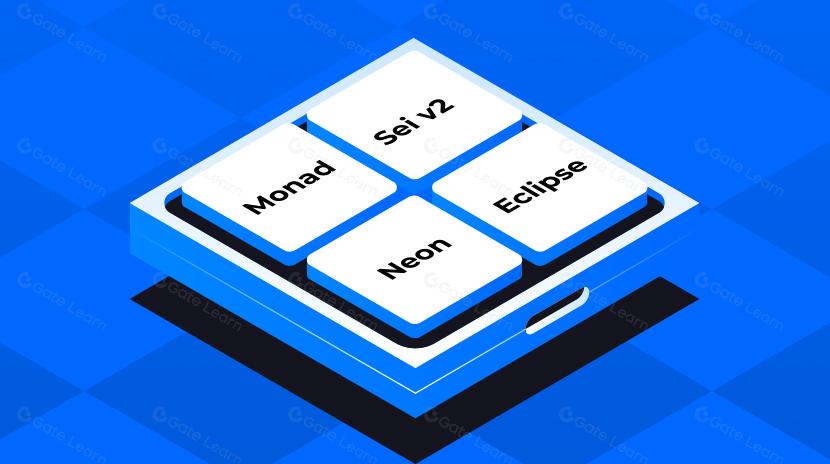
Monad is a high-performance EVM blockchain that utilizes the Monad BFT consensus protocol and parallel execution technology to enhance scalability and transaction speed. Sei V2 is an upgraded version of the Sei network, supporting backward-compatible EVM smart contract porting and Optimistic parallelization. Eclipse is a next-generation Optimistic Layer 2 solution that integrates Neon EVM for full EVM compatibility, aiming to address Ethereum's scalability challenges. Despite skepticism, Eclipse merges the advantages of Ethereum and Solana, supporting DApp-specific Layer 3 Rollups, and has strong competitive potential. Long-term success depends on attracting developers and building a robust community.
2026-04-07 20:32:17
Stacks is a long-term project aimed at turning Bitcoin into a productive asset by establishing bidirectional connections with Bitcoin and rapidly producing blocks. Following the upgrade, users can generate sBTC on Stacks, equivalent to BTC at a 1:1 ratio, without any fees. The Stacks team is dedicated to cultivating the Bitcoin ecosystem, boasting a strong technical background and extensive experience. While the valuation of STX is relatively low, the potential for development is worth noting, especially with the convergence of bullish factors such as BTC L2 narratives and the Nakomoto upgrade. Investors may keep an eye on the development of the upgraded DeFi ecosystem and the adoption of sBTC.
2026-04-07 20:22:41
The Avalanche network aims to build an interoperable, flexible, and high-performance blockchain, steadily emerging as the premier platform for constructing high-performance blockchains.
2026-04-07 20:18:55
Polyhedra Network aims to build the next generation of Web3 interoperability and scalability infrastructure, enabling asset transfer, messaging and data sharing through advanced zero-knowledge proof technology. Its core technology includes the fastest zero-knowledge proof algorithm and consensus proof, and has connected more than 25 public chains. zkSNARK is a cross-chain protocol that guarantees strong security and efficient verification costs, and provides a trustworthy cross-chain infrastructure for layer1 and layer2 interoperability. Polyhedra Network has received 4 rounds of financing, the token name is ZK, and the total amount is 1 billion.
2026-04-07 20:15:23
ZetaChain is a cross-chain platform that uses its native token, ZETA, to facilitate cross-chain message transfers. It is capable of interacting with assets that do not support smart contracts and can construct specialized protocols. The ZETA token plays a crucial role in network incentives, transaction fees, and governance. Compared to its competitor, LayerZero, ZetaChain has an advantage in the realm of full-chain smart contracts. Axelar is another cross-chain communication platform that ensures security using MPC and the AXL token, and guarantees the authenticity of information through an oracle network and risk management network. ZetaChain aims to address the issues of blockchain fragmentation and insufficient interoperability, but still faces security risks. The ongoing development and evolution of this and other technologies are anticipated.
2026-04-07 20:11:39
Merlin Chain’s independent online line has been online for 30 days, TVL has reached an astonishing level, and Merlin ecological projects have announced important actions. Learn about the latest developments in projects such as MerlinSwap, Dragonverse Neo, UniCross, Surf Protocol, and bitSmileyDeFi, and their contributions to the Bitcoin second-layer network.
2026-04-07 20:10:17
Cointelegraph recently reported on the strategic cooperation between Web3 banking protocol Fiat24 and Safepal DApp wallet: Fiat24 launched an in-DApp Web3 banking gateway and virtual encrypted payment Visa card for Safepal DApp wallet to enhance the ease of use of DApp wallet and further Open up interaction with the real world.
2026-04-07 20:08:59
The current situation where the security of tokens depends entirely on the project's self-awareness. To address this, we may need to improve token mechanisms or introduce effective token supply monitoring schemes to ensure transparency in token quantity changes. We need to be vigilant, as while people's awareness of fraud is increasing, attackers' anti-fraud techniques are also constantly evolving. This is an ongoing game, and we need to continue learning and thinking to protect our interests.
2026-04-07 20:07:36
This article summarizes the content of a speech titled "Bitcoin Renaissance: Why & How?" from Bitcoin Singapore 2024, focusing on the viewpoint that blockchain does not need to be entirely on-chain.
2026-04-07 20:06:19
Following the AO launch event, the Arweave ecosystem once again captures attention. PermaDAO invites experts to discuss AO's concepts, design, and user experience, focusing on the new opportunities it brings to developers and the entire blockchain industry, as well as its impact on shaping a new narrative.
2026-04-07 20:05:15
A public chain is a decentralized, open and transparent blockchain technology system. It allows anyone to participate and ensures tamper-proof transactions through consensus mechanisms and smart contracts. Its development has gone through enlightenment, infrastructure construction, and ecosystem competition. These three stages to solve performance, scalability and market demand issues.
2026-04-07 20:04:13
This article provides a detailed introduction to the technical implementation of the Entangle project, the product logic, and the relevant situation concerning the NGL token.
2026-04-07 20:02:46
The monolithic blockchain is the first way to build a blockchain, but scalability issues have led to the emergence of modular blockchains. This article compares modular blockchains with monolithic blockchains, helping you understand the advantages and disadvantages of both types of blockchains.
2026-04-07 20:01:32