
On April 1, Arkham, an on-chain data platform, disclosed that EdgeX, a decentralized derivatives exchange, officially claims to have airdropped about $195 million worth of EDGE tokens to users, but after on-chain analysts raised questions, the project team admitted that 14% of the total supply (about 141.6 million EDGE tokens) was actually allocated to partners and liquidity providers (LPs). Based on current valuations, that amounts to approximately $94.6 million.
A closer look at the airdrop: the real breakdown behind the $195 million
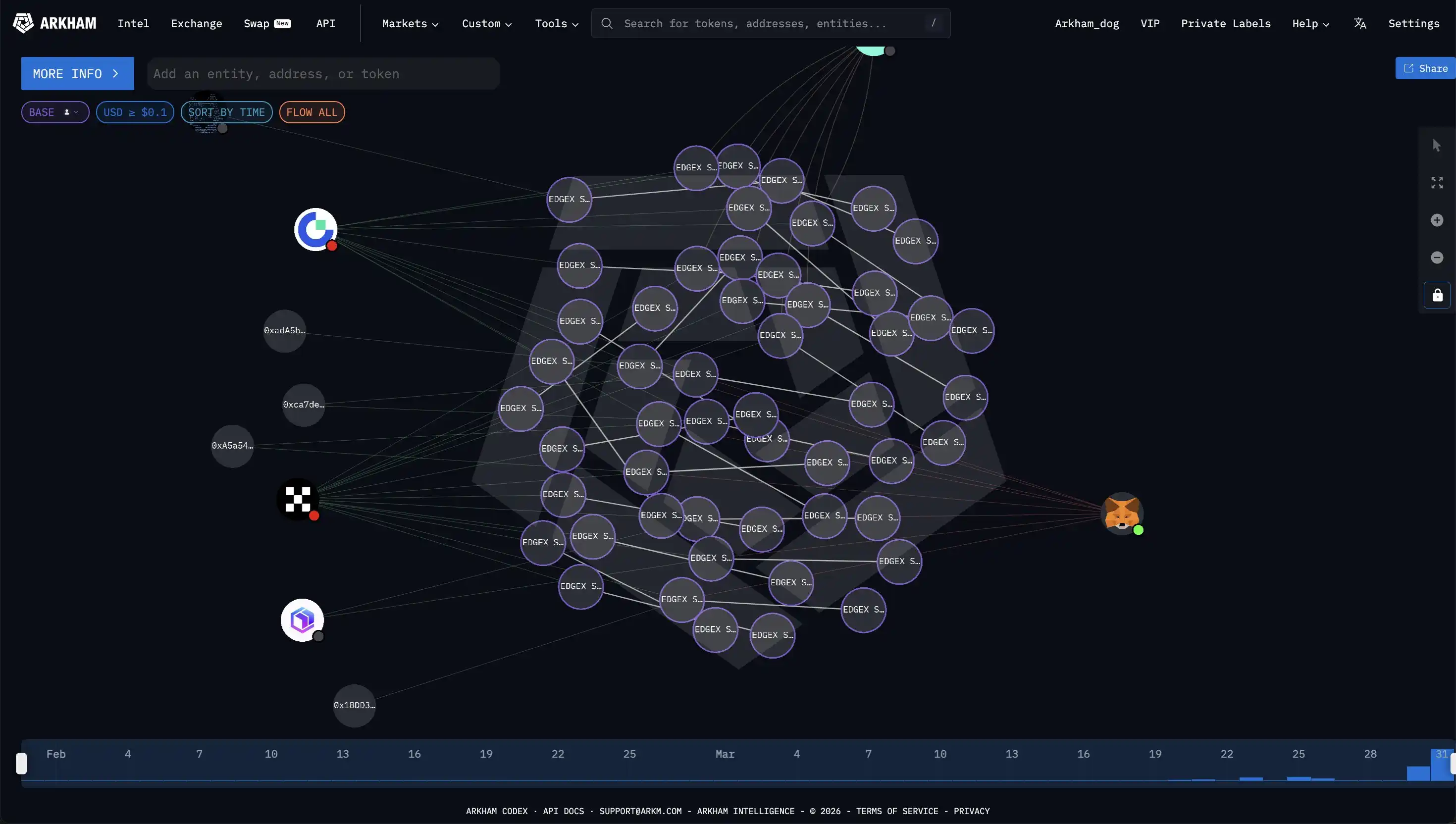 (Source: Arkham)
After EdgeX completed the EDGE token generation event (TGE) and launched a points-based airdrop, on-chain data shows that about 14% of the token supply flowed to just a handful of large wallets, immediately sparking strong community backlash over allocation fairness—are these tokens truly part of the share of the airdrop meant for ordinary users, or were they pre-allocated in advance to related parties?
According to Arkham’s on-chain analysis, the current distribution of EDGE tokens is as follows:
About 69.5%: Still held in developer-related wallets and has not entered market circulation
About 14%: Distributed under the label of “partner and LP incentives,” triggering major controversy in the community; valued at approximately $94.6 million
About 7%: No distribution has been carried out yet
About 9.5%: The portion of tokens currently actually circulating in the market
Comparing the nominal total airdrop amount of $195 million with the $94.6 million that actually went to partners, the latter represents about 48.5% of the former—meaning nearly half of the “airdrop” funds ultimately ended up in partners’ pockets, rather than ordinary community users.
EdgeX’s response: post-event lockup and the official explanation
In response to strong community pushback, EdgeX issued an official response on the X platform, acknowledging that these 141,658,500 EDGE tokens have been transferred into a VestingWallet contract audited by OpenZeppelin, with a lockup period of one year.
EdgeX provided the following explanation for the allocation logic: these tokens were intended for early liquidity providers (LPs) and partners. They contributed substantial liquidity according to the rules of the incentive program and provided meaningful support during the platform’s early phase. The allocation standard was the same as for ordinary users, and the relevant addresses actively agreed to accept a one-year lockup period.
However, critics pointed out that after the TGE was completed, and before external analysts questioned it, this portion of the allocation had never been clearly disclosed to the community, indicating a clear lack of transparency. The scale of the 14% allocation (valued at approximately $94.6 million) is also far beyond what is typically expected for ordinary “partner support fees.”
Frequently Asked Questions
Why is EdgeX’s actual circulating proportion only 9.5%?
According to Arkham’s on-chain analysis, about 69.5% of EDGE tokens are still held in developer-related wallets. An additional 7% has not yet been distributed. 14% was allocated under the names of partners and LPs and is already in a one-year lockup state. Only the remaining ~9.5% is the portion of tokens that is truly circulating in the market.
Have the 14% of EDGE tokens allocated to partners and LPs already been locked?
Yes. EdgeX’s official statement says these tokens have been transferred into a locked status via the VestingWallet contract audited by OpenZeppelin, with a lockup period of one year. The community’s main criticism is that this allocation was not publicly explained until after external analysts questioned it, and the initial disclosure lacked transparency.
Why did this incident trigger such a strong community reaction?
An airdrop is a core mechanism through which crypto projects give back to the community. If nearly half of the airdrop amount actually went to “partners and LPs” rather than ordinary users, and was only explained after the fact, it could, in reality, trigger deep doubts about allocation fairness and widespread concern about the potential influence of large token holders on the liquid market.
Disclaimer: The information on this page may come from third parties and does not represent the views or opinions of Gate. The content displayed on this page is for reference only and does not constitute any financial, investment, or legal advice. Gate does not guarantee the accuracy or completeness of the information and shall not be liable for any losses arising from the use of this information. Virtual asset investments carry high risks and are subject to significant price volatility. You may lose all of your invested principal. Please fully understand the relevant risks and make prudent decisions based on your own financial situation and risk tolerance. For details, please refer to
Disclaimer.


